Have you ever struggled to understand electrical circuits because electricity is invisible? The best way to grasp complex, abstract systems is to map them onto something physical and familiar.
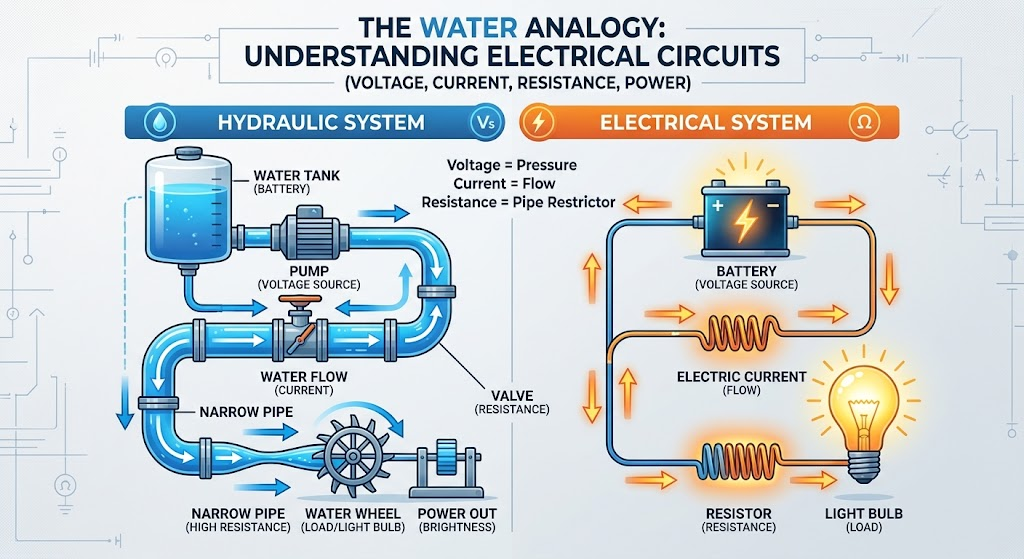
Enter the Water Analogy.
By comparing electrical circuits to plumbing, invisible concepts suddenly become tangible. Here is how the core elements translate:
- Voltage (Volts) = Water Pressure: Think of a water tank placed on a tall tower. The higher the tank, the greater the pressure pushing the water down. Voltage is simply the “electrical pressure” pushing electrons through a wire.
- Current (Amps) = Water Flow: This is the actual volume of water moving through the pipe per second. In a circuit, current is the volume of electrons flowing past a certain point.
- Resistance (Ohms) = Pipe Width: A wide pipe lets water flow easily; a narrow, clogged pipe restricts it. Electrical resistance works the same way—thinner wires or specific materials restrict electron flow, requiring more “pressure” (voltage) to push them through.
- Battery = Water Pump: A pump creates the pressure to keep water circulating. A battery provides the voltage to keep electrons moving.
Why This Matters (The Lean Takeaway)
This isn’t just a physics hack. It is a fundamental mental model for understanding any system. Whether you are analyzing traffic on a highway, data flowing through a server, or a company’s supply chain, you are always looking at three things:
- What is driving the flow? (Pressure/Motivation)
- How much is actually moving? (Current/Throughput)
- What is slowing it down? (Resistance/Bottlenecks)
Master the water analogy, and you unlock a universal framework for troubleshooting almost any system in the world.